Friday, April 6, 2012

BY HIS STRIPES

Intense week for me--Holy Week--three services in the week and three Sunday, plus an Easter Vigil Saturday night.  Counseling load is amped, too--so I turn to my friend and fellow blogger Tammie Gitt for a guest post from living3368.-steve

BY HIS STRIPES
by Tammie Gitt

The cup did not pass from him. The will of the Father was done. As the final “Amen” lingered in the air, the stillness of the night was broken by the clatter of shield against sword and the heavy footsteps of soldiers in motion. A question, a kiss and the Son of Man, who came to free the world, was placed in chains.
Every crack of the whip, every false accusation, every malicious taunt brought the prophecy of Isaiah to life as Jesus met them all with utter silence.
He was despised and rejected by men;
a man of sorrows, and acquainted with grief;
and as one from whom men hide their faces
he was despised, and we esteemed him not.
Surely he has borne our griefs
and carried our sorrows;
yet we esteemed him stricken,
smitten by God, and afflicted.
But he was wounded for our transgressions;
he was crushed for our iniquities;
upon him was the chastisement that brought us peace,
and with his stripes we are healed.
All we like sheep have gone astray;
we have turned—every one—to his own way;
and the Lord has laid on him
the iniquity of us all
He was oppressed, and he was afflicted,
yet he opened not his mouth;
like a lamb that is led to the slaughter,
and like a sheep that before its shearers is silent,
so he opened not his mouth.
- Isaiah 53:3-7 ESV
As the dawn broke, an illegally convened court turned Jesus over to a Roman leader all too willing to wash his hands of the whole affair. Pilate submitted to the will of the people and turned Jesus over to his soldiers to be crucified between two criminals.

In the early hours of a Judean spring morning, on a different hill, the One the people who had welcomed Jesus nearly a week ago was nailed to the cross. Our punishment became his to bear.
For our sake he made him to be sin who knew no sin, so that in him we might become the righteousness of God.
-  2 Corinthians 5:21 (ESV)

Monday, April 2, 2012

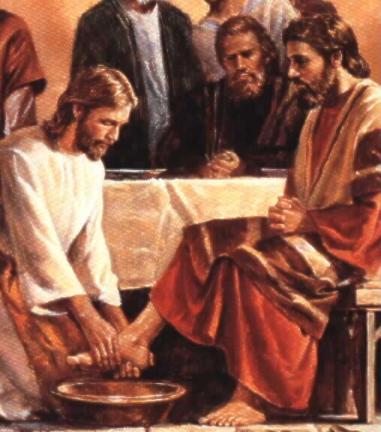
WASHING THE FEET OF JESUS - THE REPRISE

As we begin Holy Week, I have chosen to reach into the archives of THRIVING IN CHRIST.  This is the all-time most popular post for this devotional blog.  It was originally published April 1, 2010.

WASHING THE FEET OF JUDAS


Reading: John 13

John, chapter 13, records the feetwashing that took place at the Last Supper. When you put all of the accounts together from the four gospels something important emerges. Jesus washed the feet of disciples prior to the communion. Judas left during the communion but he was still present for the feetwashing. This means Jesus washed the feet of the one who was about to betray him.

This adds a whole new significance to this act of servanthood on Jesus' part. He wasn't just washing the feet of the men who he would make the first members of the Body of Christ, but also the one who would reject Jesus and never see that day of fruitfulness.

Servanthood is hard. We easily do it to those who love the Lord. We work a little harder at those who need help but may not be grateful. But washing the feet of one who would stab us in the back, who was an enemy? Perhaps that, too, is what John meant when he said that through this feetwashing Jesus was revealing the full measure of his love.

God's love loves and even serves God's enemies.

(C) 2010 by Stephen L Dunn

Friday, March 23, 2012

"LET'S GO FOR A MILKSHAKE"


Reading: Matthew 18:15

“If your brother or sister sins, go and point out their fault, just between the two of you. 
If they listen to you, you have won them over. "


"Am I in trouble?"

This was my wife Dianne's response to an offer to take her out for a milkshake.

She wasn't in trouble. Dianne had come home from a demanding day of assisting a class with kids with multiple disabilities, only to have the day become a burden as she battled the horrendous Friday afternoon traffic.  I was simply trying to offer something as an encouragement, a.k.a., comfort food.

What Dianne was referring to was a little ritual that our family began when our children were young.  When one of them was behaving in a persistently bad way or we needed to have a heart-to-heart talk about something major, I would invite them to McDonalds for a milk shake.  It was generally a sign that they were in trouble.

We developed that method to make more palatible the need to have a confrontation over a problem that was being ignored.  Some day I'll tell you some of the stories.

People hate confrontation and will do almost anything to avoid it. They will suffer in silence while they're anger grows.  They will leave a relationship (or a church) that is precious to them. They will tell 100 other persons about the problem hoping someone else will handle it.  They'll hire a lawyer.

Confrontation and conflict resolution is a vital skill in the Body of Christ.  Avoidance or transference only drive us to be defensive instead of transparent.  The unwillingness to confront and resolve is a sin before God because it destroys the unity of the Body.

That's why Jesus taught that we should be ready to confront in love - and first by going directly one-on-one to the person who has offended you or sinned against you.

(C) 2012 by Stephen Dunn

Sunday, March 18, 2012

LIVING LETTERS

"You show that you are a letter from Christ, the result of our ministry, written not with ink but with the Spirit of the living God, not on tablets of stone but on tablets of human hearts" 
- 2 Corinthians 3:3


"If the writing is honest it cannot be separated from the man who wrote it." - Tennessee Williams

I am not clear whether or not Tennessee Williams was a Christian.  You don't have to be a Christian, however, to speak the truth.  As a writer and a student of writing, I am well aware that an author often reveals more about himself than he or she would believe.  The best writing comes from the life experience and the heart of the author. When you try writing about something you do not know, you tend to come across more shallow than significant.

Paul, of course, is known to 21st century people through his letters. He was the most prolific of the New Testament authors, and all of his writings are letters from a real person in real circumstances to real people and real churches. (Paul wrote 13 of the 27 books of the New Testament and is sometimes credited as the influence on a 14th, Hebrews).  We see Paul's spiritual maturity and we see Paul's spiritual journey in his letters. Paul's prayer for and commendation of the Corinthians was that they had so embodied the gospel that they were now reflections of that gospel, as important a communication as the letters he (Paul) had been writing.

In a world of Twitter and trivia, Facebook and foolishness, blogs and baloney, we sometimes ask ourselves whether those authors are being truthful or whether they are creating a persona that hides the real person.  And based on some things I read, I must ask, "Does this person really believe they are reflecting the real Jesus?"

As you examine yourself this Lenten season, prayerfully ask - am I living letter that clearly communicates the life-changing Spirit of Christ?

(C) 2012 by Stephen L Dunn

Tuesday, March 13, 2012

IT'S NOT MY NAME YOU'RE USING

Reading: Matthew 6.9
"Our Father in heaven, holy be your name ..."

In my first church I had a wonderful friend named Jay.  He was always telling people about his church and eager to introduce them to his young preacher.  Jay was one of the church's deacons. He was also an auto mechanic, working for a shop that serviced and sold cars imported from England and Europe.

One day he invited me to his shop to meet his boss, a man named Bob.  Bob was a tall, cheerful, and garrulous man, ideally suited to sell cars.  When we arrived at the shop, however, Bob was anything by cheery.  His head was stuck deep under the hood of a car along with his arms and hands. We heard banging and grunting and cursing.  Bob was obviously having trouble with a repair.

As we stepped up Jay began, "Bob, I'd like you ..."

Before he could complete the sentence, Bob exploded "God d.....! Jesus, H .....!" (You can fill in the blanks).

Jay, however, was still rolling and completed his sentence as Bob uttered the second, "Damn!" "... my preacher.!"

Bob emerged from under the hood, red-faced and embarrassed.  As he quickly wiped grease from his hands to shake mine, he said sheepily, "I guess I shouldn't have been talking like that in front of a preacher."

My response: "I wouldn't worry about me, it wasn't my name you were using."

At the core of Jesus' instructions to his disciples during that famous prayer lesson, we are taught to say, "Holy is your name."

How we use God's name is an expression of our reverence for Him--our honoring Him, our taking Him seriously.  It is an our expression of our recognition that He is God and His name represents His power and position and purpose.

Does the way we speak to Him or about Him reflect our recognition of His holiness?

If you'd like to learn more about the Lord's Prayer and what is means to reverence God, join us this Sunday at the church of God of Landisville as I begin a new series, "The Prayer of a Holiness-Hungry People." - Steve

(C) 2012 by Stephen L Dunn

Wednesday, March 7, 2012

AT THE CROSS


 Reading: Colossians 2:14

I grew up in a church that had a strong revivalist heritage.  Songs of repentance and confession were at the forefront of its hymnody. One of my favorites came from Isaac Watts. It is known as "At the Cross."

  1. Alas! and did my Savior bleed
    And did my Sov’reign die?
    Would He devote that sacred head
    For such a worm as I?
    • Refrain:
      At the cross, at the cross where I first saw the light,
      And the burden of my heart rolled away,
      It was there by faith I received my sight,
      And now I am happy all the day!
  2. Thy body slain, sweet Jesus, Thine—
    And bathed in its own blood—
    While the firm mark of wrath divine,
    His soul in anguish stood.
  3. Was it for crimes that I had done
    He groaned upon the tree?
    Amazing pity! grace unknown!
    And love beyond degree!
  4. Well might the sun in darkness hide
    And shut his glories in,
    When Christ, the mighty Maker died,
    For man the creature’s sin.
  5. Thus might I hide my blushing face
    While His dear cross appears,
    Dissolve my heart in thankfulness,
    And melt my eyes to tears.
  6. But drops of grief can ne’er repay
    The debt of love I owe:
    Here, Lord, I give myself away,
    ’Tis all that I can do.                         

I find that the problem for most of us not ignorance of our sin. It is forgetfulness. Just as the past often becomes more ideal in the distance of many days, sin becomes less onorous. The nature of God's forgiveness is forgetting.  But that has to do with forgetfulness of the transgressed, not the transgressor.  When we confess our sin, He is faithful and just to forgive our sins and cleanse us of all unrighteousness ... and then he forgets the sin.  He remembers it no more. It no longer separates us from him.

But as the transgressor, to forget that we have sinned--to forget sins awful consequences--is to enter a world of moral naivete where sin is likely to recur because we are not prompted to pursue righteousness.

This Lent, as you reflect on your sin and its impact, remember also the price our Savior paid for the sin we so idly commit.

He canceled the record of the charges against us and took it away by nailing it to the cross.

Wednesday, February 22, 2012

THE SPIRIT IS WILLING BUT THE FLESH IS WEAK


Reading: Mark 14:35-38

     Today is Ash Wednesday, the first day of Lent.  Lent for me is the season of reflection, confession, repentance, and refocusing.  At some point today I will go to a worship gathering to join other Christians in prayer and to receive ashes marked on my forehead in the form of a cross.  It will be a visible and tangible symbol of the one to whom I surrender my life and the one whose obedience makes that surrender possible.

      This occurs during the fourth week of a much-needed sabbatical.  By the end of 2011, I was pretty well fried physically and to some extent, emotionally.  My personal passion was muted.  My sleeping patterns were in great disarray. Physically I lacked the energy to do much of anything effectively for more than brief adrenalin-prompted spurts.  Emotionally I had to guard my attitude and reactions because I was being drained but what seemed to be a constant stream of problems laid on my desk for solving. Spiritually, I had to keep pushing the pile aside to see the Lord.

     The sabbatical has been a good thing for me, not a cure-all, but a good beginning.  Initially, the agenda was simply to rest; and then to exercise and change some eating and sleeping patterns that would begin contributing to a return to health.  It has taken me, however, into this fourth week to see a modicum of progress.  Initially, I had to address the sleep issue because the sleeplessness robbed me of the energy to exercise very much at all.  Then when the sleep started balancing, I found a body crying out against exercise because it was too tight, too flabby, too sore—so that almost any exercise was a source of pain, sometimes spirit-draining pain.

      The spirit was willing, but the flesh was weak.

     That has begun to change, and I will have to keep a willing spirit when I return from this sabbatical because the demands of my work will once again work against my flesh.  But having a glimpse of a better outcome, I intend to press on in this path that God has laid out.

     Jesus, as well, had a difficult path to follow.  In the near term it would be costly and painful.  In fact, it would lead to his death so that we might have life.  His partners had trouble supporting him in prayer because their physical weakness was overwhelming their spiritual calling. Later, some of them, too, would have crosses.

    When the flesh is weak, we need to let the Spirit lead and empower.  We need to keep our lives fixed on the will of God or our weakened flesh will keep us from the purposes of God.  Look to the Cross, its price, its purpose, but also its outcome—and commit anew  this Lenten season to the purposes of God in your  life.

© 2012 by Stephen L. Dunn